I got asked recently: “What type of mobile home parks do you buy?”
Easy answer: Value-add mobile home parks.
But what does that actually mean?
Ever seen Fixer Upper on HGTV? You know how they take an old house, rip out the ugly 1970s carpet, knock down some walls, and turn it into something livable again? That’s exactly what we do—except instead of one house, we’re doing it with an entire mobile home community.
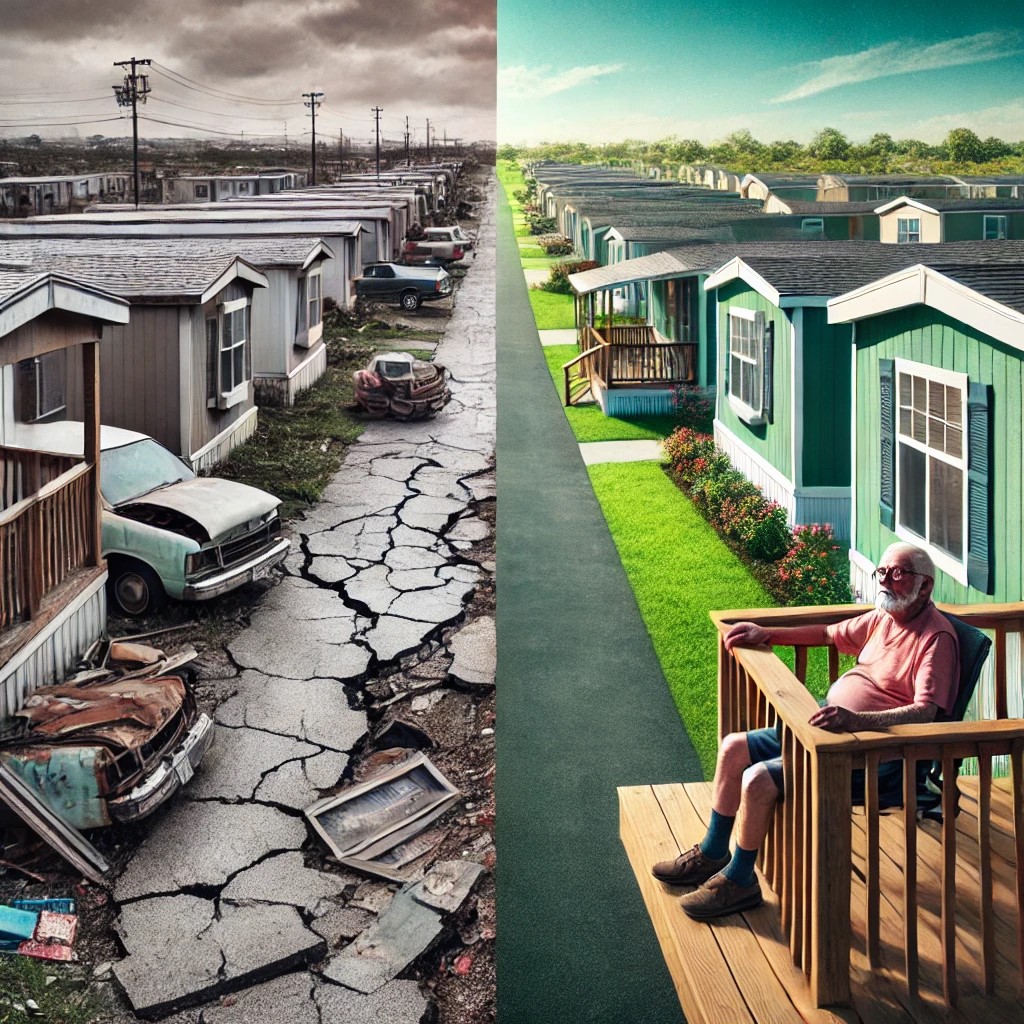
“Value-add” is just a fancy way of saying Fixer-Upper. There’s value that’s buried under years of neglect, bad management, and deferred maintenance, and if we do the work, we get rewarded financially.
As far as I’m concerned, there are only two types of mobile home parks:
- Value-Add – Needs work. That’s what we buy.
- Stabilized – Already cleaned up, fully occupied, and running smoothly.
Stabilized parks can be great for long-term wealth preservation. Although there are different degress of “stabilized” parks, since most of the heavy lifting has been done, they don’t leave much room for investors to come in and multiply capital fast. The price is higher, the return is lower, and while they’re easier to manage, it’s just not where we are in our stage of scaling.
We’re not looking to park money—we’re looking to put in work, create value, and then hold an asset that generates wealth for decades.
What Does Value-Add Actually Cover?
When we talk about value-add in mobile home parks, we’re talking about everything that needs fixing, upgrading, or restructuring to unlock a park’s full potential. It’s not just one thing—it’s a combination of physical improvements, operational overhauls, and dialing in the business side.
Here’s what that looks like in action:
- Vacant Lots – Filling empty spaces with new homes, whether the lots are already developed or need infrastructure.
- Vacant Homes – Rehab and get them move-in ready. No sense in having an empty home sitting there, losing money.
- Infrastructure & Property – Upgrading water and sewer lines, fixing electrical, repairing roads, improving signage, landscaping—basically, making the place look and function like it should.
- Low Rents & Leasing – Raising rents to market rate, splitting lot rent from home rent where it makes sense, putting in real leases instead of handshake deals, setting community rules, and billing back utilities so the park isn’t eating unnecessary costs.
- Staffing Issues – Hiring, firing, and restructuring the team to streamline operations and make sure everyone is either pulling their weight or getting replaced.
- Missing Processes & Systems – Setting up online rent payments, maintenance request systems, marketing, branding, and websites—the kind of stuff that brings the park into the modern world.
Breaking It Down: Field & Operations (F&O)
Every park we buy has two categories of problems—Field & Operations. Or as I call it, F&O.
Some parks are heavy on the Field side—tons of vacant homes, busted-up roads, old sewer lines, and just a lot of physical work. These deals require more vendors, more labor, a bigger budget, and a longer timeline to turn around. But when done right? That’s where you squeeze the most value out.
Then there’s the Operational side—low rents, missing leases, sloppy management, unqualified tenants, staff issues, and a complete lack of systems. These things take less manpower to fix and are more administrative, but they still make a massive difference in the park’s performance.
Most parks we buy need work on both sides, but some lean heavier one way or the other. The bigger the mess, the bigger the opportunity.
Why Do These Parks Exist?
It seems obvious, right? Someone neglected them. They stopped doing the work.
But why? Who would let an entire mobile home community fall apart? Turns out, there are a few common types of sellers when it comes to value-add parks.
1. Mom & Pop Owners
This is the most common seller we deal with. They either built the park themselves or bought it decades ago and have been living off the income ever since.
They do most of the work themselves—mowing, collecting rent in person, handling repairs (or patching them up just enough to last). They’ve run it their way for years, but now they’re older, tired, and just don’t have the energy or the capital to keep up with it anymore.
Sometimes, they pass the park down to their kids, but here’s the problem—the kids don’t want it. They don’t live nearby, they have no interest in running a mobile home park, and they just want to cash out. So the park sits and declines until they decide to sell.
2. The Uninformed Investor
This guy thought he was buying an apartment complex with trailers. He jumped into the MHP space assuming it was just like any other real estate investment.
Then reality hit.
- Maybe he hired a third-party manager who ran the park into the ground.
- Maybe he thought it would be passive and quickly realized mobile home parks require actual work.
- Maybe he just wasn’t ready for the tenant base, the infrastructure headaches, or the complexity of infill.
Either way, the park starts bleeding money, and before long, he’s desperate to get out.
3. The Burned-Out Investor
This guy had the right idea but the wrong execution. He started out thinking he could turn the park around, but then ran out of money, energy, or both. He got in too deep.
Maybe he underestimated how much capital was needed to fix things.
Maybe he didn’t have the right team to execute the turnaround.
Maybe he got overwhelmed with management issues, city code problems, or high vacancy.
Either way, he got in over his head, and now he just wants out.
The Pattern is Always the Same
No matter which type of seller we’re dealing with, it always comes down to two things: money & skill.
- If they had the money, they would have fixed it.
- If they had the skill, they wouldn’t be in this position.
But they don’t—so they let the park decline until the problems get too big to ignore, and that’s when we step in.
Why Do These Parks Decline?
It’s easy to assume that a rundown mobile home park is the result of a bad owner—someone who didn’t care or was just lazy. But that’s not always the case.
At the end of the day, there are only two real reasons a property declines: Money & Skill.
The owner either didn’t have the money to keep up with repairs, or they didn’t have the skill to run the park properly. Sometimes it’s both.
One of the best ways I explain value-add MHPs is by comparing them to single-family homes.
The Single-Family Home Analogy
Think about an old house. As time goes on, things start to break down and wear out. The roof needs replacing. The AC dies. The siding starts to rot. The kitchen gets outdated.
If the homeowner has money set aside or knows how to fix things themselves, they can keep the house in good shape.
But if they don’t have $15K for a new roof, what do they do?
They throw a tarp over it and hope for the best.
If they don’t have $8K for a new AC?
They put in some window units and suffer through the summers.
If they don’t have $25K for new siding?
It just sits there and rots.
Eventually, the house gets so bad that it’s no longer a simple fix. It becomes a full renovation project, and the owner is forced to sell at a discount to someone with the money and skills to fix it properly.
Same thing happens when someone inherits a home. The relatives don’t live nearby. They don’t want to deal with it. They don’t have the time, money, or skills to fix it up. So they let it sit until it degrades even further—until finally, they sell it to an investor who will do the work.
Now Apply That to Mobile Home Parks
A mobile home park is no different.
We buy parks from original owners, aging owners, or people who have owned them for 20+ years. And just like a house, over time, things wear out. The difference? Instead of one roof, there are 30 that need replacing. Instead of one AC unit, there are 30 that need repairs. Instead of one driveway, there are roads that need repaving.
All of this takes serious capital.
Now, you might be thinking—“Well, if they have 30 homes, they’re making $15K or $20K a month on rent, right? Shouldn’t they be able to afford it?”
Ah, and that’s where most people are wrong.
Some park owners do set aside money for repairs, just like a responsible homeowner with a maintenance fund.
But those aren’t the ones we buy from.
The ones we buy from? They’re living off the income from the park.
Why These Parks Fall Apart
A lot of these owners rely on the park’s rental income to pay their bills, fund their retirement, and cover day-to-day expenses.
Let’s say the park brings in $20K a month in rent.
- After operating expenses, they might take home $12K.
- If they have no mortgage, that’s what they live on.
- If an AC or a roof needs replacing? That’s a $6K hit—half of their income for the month.
So instead of fixing it properly, they patch it up and keep going.
I bought a community just like this from an original owner. He was collecting $20K a month, doing all the repairs himself, mowing his own yards, and collecting rent in person.
But when something broke? It was never fully fixed. Why? It was his sole income. He lived off that money he collected. The more he did himself, the more money he kept, the cheaper the repairs the more money left over.
We walked in and found 36 AC units that were barely hanging on. Most were from the early 2000s, and a few were even from 1995. Our HVAC tech told me, “I never see units this old still running.” The owner kept them going as long as humanly possible just to avoid writing a big check for replacements.
And that’s how these parks end up in the condition we find them.
Why Do These Parks Have High Vacancies?
A lot of times, when we step into a value-add deal, we’re looking at a park with a high number of empty lots or abandoned homes. Why? Because filling those lots or rehabbing those homes costs money.
The owner has two choices:
- Invest back into the park—bring in homes, fix up vacancies, and grow the income.
- Do nothing—keep the money they’re making and avoid big expenses.
Guess which one most struggling owners choose?
They don’t want to reinvest because it would eat up all or more of what they take home each month. So as lots and homes become vacant, they sit empty. Over time, the park starts earning less and less, and because mobile home parks are valued based on their income, that means the property itself is losing value.
And here’s the ironic part: by avoiding spending money, they’re actually making their park worth less. It’s a slow-motion downward spiral.
The Third-Party Manager Problem
Now, not every park we buy is from an aging Mom & Pop owner. Another major source of value-add deals? Parks that were mismanaged by third-party property managers.
This usually happens when an investor buys a mobile home park but has no experience actually running one. They don’t want to deal with tenants, maintenance, or operations, so they hire a management company. Makes sense, right?
Except here’s the problem: Most third-party managers in this space are terrible.
Running a mobile home park is not like managing apartments or single-family rentals. It’s a full-time business, and most property management companies just aren’t equipped for it.
I’ve been under contract on two parks that were run by third-party managers, and both were so badly mismanaged that we had to walk away.
- One manager was straight-up stealing money. Billing the owner for work that was never done. Rent collections were low, non-paying tenants were piling up, and properties were being trashed.
- The other manager was just completely incompetent. They had high vacancies and blamed the owner for not giving them enough money to fix anything.
The second park was earning $50K a month just a few years earlier. By the time we looked at it, income had dropped to $40K because of unpaid rents and vacancies.
We went through the financials and saw the truth:
📉 They were losing money every single month.
📉 The owner had to pour money into the park just to keep it afloat.
📉 The manager had overstaffed the park with high-salaried employees, eating away at profits.
📉 The owner had never even met the staff—he lived on the other side of the country.
To make matters worse, the infrastructure was failing—sewer and water lines were constantly breaking, costing $2K per repair. Add that on top of all the other financial issues, and suddenly, this “passive” investment was an absolute money pit.
That’s when the owner hit their breaking point. They were hemorrhaging money, and they just wanted out.
This is what happens when investors jump into mobile home parks without fully understanding what they’re getting into.
The Complexity of Running a Mobile Home Park
Running a mobile home community—whether it’s 30, 100, or 200 lots—is a real business.
✅ You have to be hands-on. It’s not like owning apartments where tenants just move in and out.
✅ You have to understand the tenant base. MHP tenants are a more eclectic, diverse group than traditional renters.
✅ You have to manage infrastructure. Sewer, water, roads—things that apartment landlords never have to think about.
I’ve seen too many investors buy a park without a plan because they heard mobile home parks were a great asset class. Then, within a few years, they’re scrambling to get out because they realize it’s more work than they expected.
One of the worst cases I saw was an owner who 1031-exchanged into a mobile home park thinking it would be passive.
🚨 Two years later, they had lost 1/3 of their tenants.
🚨 They had no idea how to turn it around.
🚨 They were desperate to sell and get back into multifamily.
This happens more than you’d think, especially with mobile home parks getting hyped up on social media. People buy in because they think it’s easy, only to find out it takes real work
Why Don’t Owners Just Raise Rents?
This is a question I get all the time.
“If rents are too low, why don’t owners just raise them and fix all these problems?”
Simple answer: They don’t want to rock the boat.
Their park is paying them just enough to live on, so they’re happy.
But the real reason runs deeper.
- They know the tenants personally.
- They hear every sob story.
- They don’t want to be the bad guy.
So instead of raising rents over time, they keep them the same for years. Meanwhile, expenses keep going up, and before they know it, they’re barely breaking even.
I bought a community where lot rents were $175/month in a market where they should have been $400–$450. On top of that, the owner was paying for water, sewer, and trash.
He was barely making money—but he refused to raise rents because he knew all the tenants personally.
Then he passed the park down to his kids.
The kids didn’t want it.
They didn’t live nearby.
They didn’t know how to run it.
So the park started spiraling. The casino next door wanted to buy it just to tear it down.
That’s when we stepped in.
And no, the tenants weren’t happy when we started raising rents and putting new systems in place. But we were ready and willing to deal with that blowback because we knew what had to be done to keep the park alive.
This is why so many parks fall into decline.
📉 Owners get stuck in a cycle of low rents, declining conditions, and eventual failure.
📈 A professional operator steps in, raises rents responsibly, reinvests in the park, and turns it into a long-term, sustainable community.
That’s what value-add is all about.
Why Can We Do This When the Current Owners Can’t?
It always comes back to the same two things: Money & Skill.
Most of the owners we buy from don’t have one or both. They either can’t afford to make the necessary improvements or don’t have the knowledge, systems, or team to execute a turnaround.
This is what separates us.
The Key Difference: Capital & Execution
Think about those HGTV home renovation shows. The flippers don’t buy a fixer-upper with their last dollar. They come in with a budget, a plan, and a team to get the work done efficiently.
That’s exactly how we approach mobile home parks.
- Before we even close on a park, we create a detailed plan: What’s broken? What needs to be fixed? Where can we extract the most value?
- We raise capital to cover everything upfront. Unlike Mom & Pop owners who rely on monthly cash flow to survive, we have reserves set aside to get the work done fast.
- Investors don’t have to wait years for results. Because we’re funding improvements separately from operational cash flow, investors start seeing distributions while the turnaround is happening.
That’s the difference. Most owners are playing defense, barely keeping their parks running. We come in playing offense, fixing things immediately and building long-term value.
The Right Team for the Job
Money alone isn’t enough. It’s about having the right team.
Running a mobile home park isn’t just about collecting rent. It’s about People, Processes, and Product.
✅ People: We bring in the right staff, train them, and replace anyone who isn’t pulling their weight. A Mom & Pop might hesitate to fire an underperforming employee, but we make decisions based on business, not emotions.
✅ Processes: We implement tenant screening, rent collection systems, leasing procedures, maintenance protocols, and digital portals to professionalize the operation.
✅ Product: A park is only as good as its homes. We rehab, maintain, and upgrade properties so they don’t sit vacant and deteriorate.
Unlike absentee investors or passive landlords, we are hands-on.
- We visit our communities regularly.
- We meet tenants and ensure standards are upheld.
- In some cases, we even live onsite for a period to oversee the transition.
This is why our model works—because we don’t just own the parks. We operate them.
What’s the End Game?
Our goal with the value-add strategy is simple: Buy the park, execute the business plan, and build long-term wealth.
This process typically takes 5+ years, depending on the condition of the community.
- We secure financing with a balloon payment that aligns with our turnaround timeline.
- Over time, we fix vacancies, improve infrastructure, raise rents responsibly, and stabilize operations.
- Once the park is performing at a higher level, we refinance into better long-term debt.
At refinance, we return investor capital and distribute any excess proceeds to our Capital Partners.
But here’s the best part: We don’t sell. We hold.
Once the heavy lifting is done, the park becomes a long-term cash-flowing asset that keeps paying out quarterly distributions to our partners.
How Investors Benefit from Value-Add MHPs
- We Find the Deal – We source off-market and undervalued parks that need work.
- We Build the Business Plan – We identify what needs fixing—vacancies, infrastructure, management, and rents—and create a step-by-step turnaround plan.
- We Secure the Right Capital – We raise money upfront so we have the reserves to execute the plan without draining cash flow.
- Investors Get Paid While We Execute – Rental income still flows, providing returns (typically 7–9% preferred).
The Park Becomes a Long-Term Asset – After stabilization, the park is more valuable, produces stronger cash flow, and gets refinanced into better financing
Why This Strategy Works
We look at mobile home parks as one of the best tools for:
✅ Wealth Preservation – A hard asset that holds value over time.
✅ Capital Multiplication – Extracting value through improvements and stabilization.
✅ High Cash Flow – A consistent income stream from lot rent.
✅ Tax Efficiency – Depreciation benefits that offset taxable income.
The value-add component accelerates capital growth compared to buying a fully stabilized park. Yes, it takes more work, more skill, and more effort upfront, but in return, we capture higher returns and create an asset that builds wealth for decades.
This isn’t a fix and flip—this is buy, improve, and hold.
The Lesson: Find the Right Partner
If you’re investing in mobile home parks but don’t want to be a hands-on operator, then you need the right partner.
🚨 Most third-party managers fail. They don’t have a vested interest in growing the asset, so they won’t protect, preserve, and optimize the investment the way an owner will.
🚨 Value-add strategies require capital and skill. If you don’t have both, partner with someone who does.
At the end of the day, creating value takes work. But if done right, it turns a neglected, underperforming park into a highly profitable, long-term asset.
Final Thoughts
Mobile home parks are one of the best real estate assets for long-term wealth building, capital multiplication, and passive income. But value-add investing isn’t for everyone. It takes capital, skill, and execution.
Most owners who sell to us either don’t have the money to improve their parks or don’t have the ability to manage them properly. That’s where we step in—bringing in the capital, the expertise, and the right team to turn struggling parks into high-performing assets.
For investors, that means getting paid while we execute, building equity along the way, and owning a stabilized asset that produces long-term cash flow.
If you’re considering investing in mobile home parks, find the right operator—because in this business, execution is everything.
Did you Like this?
If you want to talk about Single Family houses and why they are the worst investment to make in Real Estate, Passive Investing, or just Park Operations in general, use this link to set up a Zoom Call with me. Let’s Talk!
Lock N’ Load
–The MHP Operator
Disclaimer: The information provided in this article is for educational and informational purposes only. It is not intended as financial or legal advice. I am not a licensed financial advisor, lawyer, or CPA, and you should consult with a licensed professional before making any legal or investment decisions.



Leave a Reply