
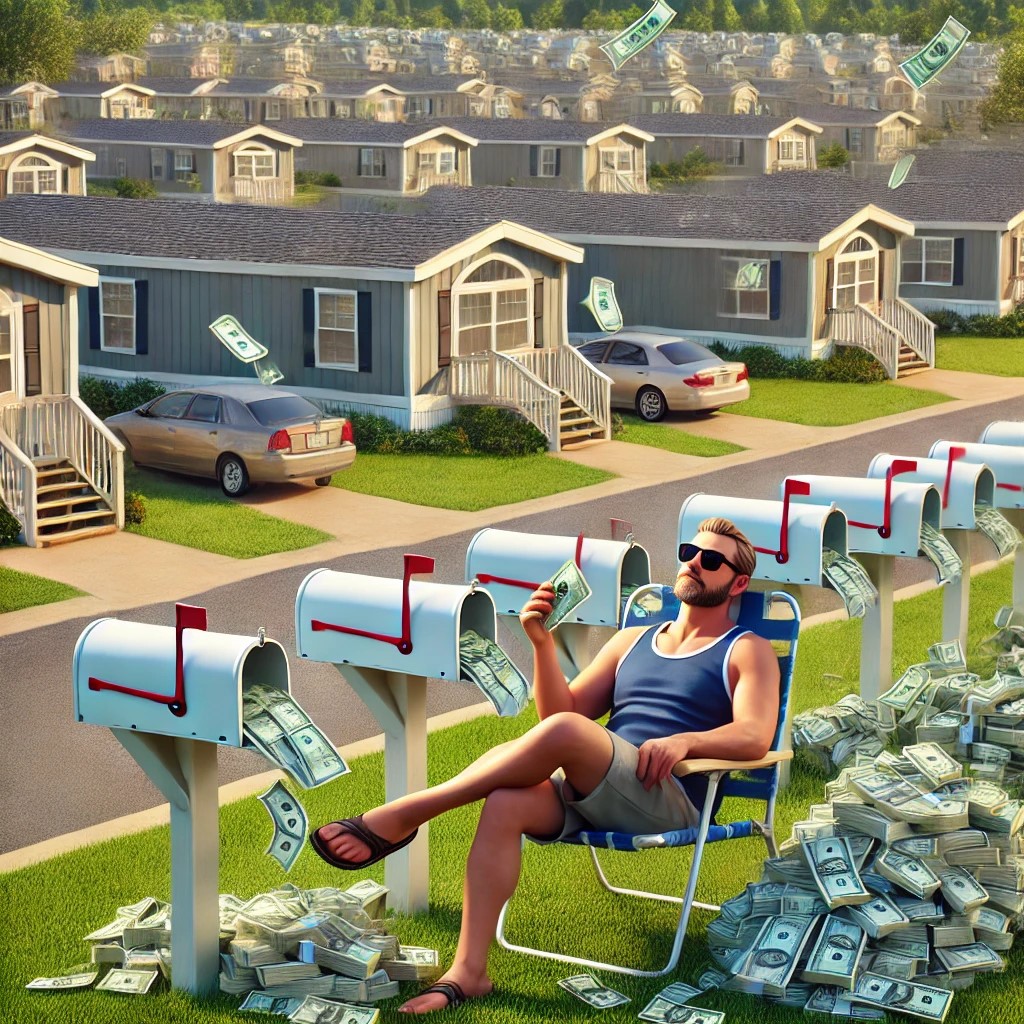
We’ve all heard it before, right? “Buy rental properties, and you’ll be rich!” It’s one of those myths that’s been passed around for years, like some magic formula for wealth-building. People buy a couple of houses, collect rent, and—boom—they’re set for life. That’s the dream, anyway. It sounds simple enough: Just buy a house, rent it out, and wait for the money to roll in.
But here’s the thing—they leave out the messy parts. The late-night calls from tenants, the repairs you didn’t plan for, the constant juggling of maintenance, vacancies, and all the other little surprises that come with owning rental properties. It’s not as smooth and easy as they make it sound. And it definitely doesn’t create the kind of wealth you were promised. In fact, most people get stuck in the cycle of putting out fires, and before they know it, they’ve got a bunch of properties, but not a lot of real wealth to show for it.
The truth is, SFRs are marketed as the go-to for building passive income, but that’s only part of the story. So, what if there’s a better way? What if there’s a path to real wealth that’s not as complicated, not as time-consuming, and definitely not as frustrating? That’s what we’re about to explore
Why?
Why are single-family houses pitched as great investment properties? Well, at one time, they were. They were cheap to acquire, there was a steady supply of homes, and rental prices were at a level that made it feasible to profit from them. But with the current economy and housing prices skyrocketing, the days of cheap rentals are long gone. Repair costs have also risen dramatically, and suddenly, those repairs hit your bottom line much harder than they ever did before.
The truth is, it all comes down to Realtors. They’re pushing the product they sell because that’s how they make their fees. Only 22% of Realtors actually own investment properties themselves. They make more money managing your rental property than they would by owning their own. Think about it: a 10% management fee plus the first month’s rent for a new tenant—that adds up quickly. Especially when the average turnover rate for a house tenant is about 24 months.
Single-family houses also have a much lower barrier to entry for the average middle-class American. You can buy one with a 20% down payment and a standard loan. More often than not, you can do this on your own without needing partners or pooled capital. Because of this, single-family homes have become the go-to for getting into real estate as an investment. But just because it’s easier to get into doesn’t mean it’s the best choice in the long run.
The Misconception
Let’s talk about the “passive income” pitch. When you look closer, you’ll see that it’s anything but passive. If you decide to manage the property yourself, you’re taking on a second job. Many investors do this to avoid paying management fees to a property management company. They think they can save money by handling repairs themselves or by price-shopping for labor.
But managing a rental home yourself? It’s exhausting. Late-night tenant calls, complaints, late rent, damage to the property—the list goes on. And there’s no schedule to it. One month, everything’s quiet. The next, it feels like the house is falling apart. You’re always putting out fires.
Now, hiring a property manager can reduce the hands-on work. But they can only do so much. They don’t own the home, so they’ll need your approval for expensive repairs. And let’s face it—they’re not as motivated to keep costs down when it’s your money on the line. Every month, you get a check with a list of expenses, but it’s still up to you to keep your own books for tax season.
So What’s the Other Option?
Mobile Home Parks (MHPs) are a better option for building a rental portfolio of high-performing real estate assets. Let’s talk about why.
Why MHPs Are Great
Mobile home parks share similar attributes with single-family homes—standalone structures, their own driveway, their own yard. They often come with a porch or deck, typically 3 beds and 2 baths, and sizes that are comparable to your typical rental homes. They’re in a neighborhood setting, just like houses within a subdivision.
But here’s where they differ: every home in the park either belongs to you or is paying you rent for the land it occupies. You own the entire neighborhood. This creates a lot of synergies. For example, you’re able to get better pricing from vendors because of the volume of work you’re giving them. Take lawn care, for instance. Cutting 20 lots in one park without driving to each individual home saves the vendor time and gas, which means better pricing for you. Compare that to 20 houses spread across the county, where time and travel alone add a significant cost. That cost can quickly add up and create a surcharge to your monthly bill.
One of the biggest advantages is having an onsite manager. When your community is big enough, you can have someone onsite managing the day-to-day. Now, you might think this is similar to hiring a property manager for single-family rentals, but it’s not the same. Often, an onsite manager will keep an eye on the property, meet vendors, and even handle prospective tenants—all for as little as free rent. As the park grows, so does the manager’s responsibilities, and of course, the pay. But even then, it’s still far cheaper than hiring a property manager for each single-family rental.
Now, Let’s Break Down the Comparison
Returns
Let’s start with what matters most—what’s going to make you the most money? Single-family houses don’t cash flow as well as mobile home parks (MHPs) and rely heavily on the appreciation of the home itself to make up most of their return.
- MHPs:
- The average annual return for MHP investors typically ranges from 8% to 15%, depending on the specific investment.
- MHPs generally offer higher cash-on-cash returns compared to single-family rentals (SFRs) because of lower operating costs and more stable cash flow.
- Investors can often increase rents steadily in MHPs (unlike SFRs, which may have rent controls or restrictions), and they have more leverage in raising rents due to the lower vacancy risk.
- The ability to raise rents and reduce expenses provides a better operating profit margin, which will increase resale value, enhancing the overall return profile of the MHP.
- SFRs:
- The average annual return on SFRs usually hovers around 6% to 10%, but this can vary depending on location, property type, and market conditions.
- With SFRs, you’ll face higher tenant turnover and additional expenses, which can lower overall returns.
MHPs consistently outperform SFRs in terms of steady cash flow and returns. This is because MHPs are easier to scale efficiently, rents can be increased with less resistance, and there are fewer property management costs. As a result, the MHP can better dictate and control its valuation. The relationship between cash flow and valuation is mutually beneficial: higher cash flow means a higher valuation.
With SFRs, it’s a different story. The valuation is mostly independent of cash flow. When I sold my rental houses before switching to MHPs, I had to repaint and upgrade fixtures to get full value. One property didn’t get the upgrades, and it sat on the market. The offers I received were lower because buyers factored in the cost to “upgrade” the home. This is a huge factor with SFRs—pricing is tied to the home’s condition. Meanwhile, MHPs focus on income and profit for their valuation, which gives them more stability and predictability.
2. Vacancy and Tenant Stability
Single-family homes have an average tenancy of about 2 years, but it can take up to 2 months to repair and re-rent the home. That’s an average of 1 lost month of rent per year. While mobile home parks (MHPs) also experience vacancies, the impact is spread across a wider portfolio. Plus, tenants in MHPs tend to stay longer than those in single-family homes.
- MHPs:
- Vacancy rates for MHPs are typically much lower, around 5% to 8%, because tenants own their homes, which makes them more likely to stay long-term.
- Even when homes do vacate, the other land rental income continues, providing stable cash flow.
- SFRs:
- Vacancy rates for SFRs can be as high as 10% to 15%, depending on location, which directly impacts your income when you have multiple properties.
- The frequent need to find new tenants for each individual home increases downtime, which eats into your profits.
- One lost month of rent, plus the cost to repair that unit, can wipe out an entire year’s worth of profit.
MHPs have lower vacancy rates, partly because tenants own their homes and are less likely to move out, making MHPs far more stable for long-term cash flow. Additionally, MHPs also have lower vacancy rates for park-owned homes due to their affordable nature. People simply can’t find a comparable, lower-cost alternative with similar features and benefits.
When I was managing SFRs, I had a tenant leave, and it took me two months to fill the unit. During that time, I had to cover the mortgage, utilities, and trash, and I also had to repaint the interior. It was a headache. Now, with my MHPs, we’re turning around one park, evicting multiple tenants, and yes, we have vacant homes. But the difference? The mortgage is still being paid by the rental income from the other occupied units in the park. We’re not hemorrhaging money like we would have on an SFR.
3. Appreciation
Single-family homes are only ever worth what the comparable home down the road sold for. You won’t get rewarded for being a great landlord or for how much rent you charge. In fact, single-family homes that were previously rentals often sell for a lower price than their owner-occupied counterparts—mostly due to the condition and quality of materials used in the home. What works well for a rental home often doesn’t add the highest value when it comes to resale, and vice versa.
- MHPs:
- While land prices can appreciate over time, the key driver for MHPs is income-based valuation, not market appreciation.
- MHPs are often purchased at a low price relative to their potential income, meaning investors can achieve significant returns—even if property values don’t appreciate rapidly.
- By increasing rents and decreasing expenses, you can accelerate appreciation more quickly.
- MHPs are less subject to market volatility because they operate primarily as cash flow-based investments, rather than relying on the appreciation of property values.
- SFRs:
- Appreciation is often the main selling point for SFRs, but it’s volatile and tied to market cycles.
- SFRs are valued based on market comparables, ignoring rental income and business operations.
- Rental homes typically have lower-quality materials and may either sell for less than owner-occupied homes or require more investment to upgrade them to realize their full value.
- The 2020-2022 housing boom saw rapid price increases, but home prices in many areas have plateaued or even decreased slightly.
- High appreciation can also lead to higher property taxes and maintenance costs, which eats into your profits.
MHPs are less dependent on appreciation for long-term gains, making them more predictable and stable. They focus on income generation, meaning investors can accelerate appreciation by increasing income, which speeds up realizing the underlying value of the property. On the other hand, SFRs rely heavily on market volatility to build wealth through appreciation, which can be unpredictable.
4. Maintenance and Operating Costs
With single-family homes (SFRs), you’ve got two choices: do the repairs yourself or hire someone. One saves you money, the other saves you time. But here’s the kicker—many landlords of SFRs end up with higher maintenance costs because they lack the scale to negotiate better pricing with vendors. If you hire a property manager, the repair costs are typically at or above market rates.
- MHPs:
- Operating costs in MHPs are usually lower because tenants own their homes and are responsible for their own maintenance.
- Maintenance costs for park-owned homes are cheaper due to economies of scale. The higher volume of work allows you to dictate better pricing from vendors.
- Mobile homes are simpler structures, and repairs/materials are generally cheaper than for SFRs.
- The ability to scale allows MHP owners to afford a team that can streamline tenant relations and maintenance, keeping operating costs low and saving the owner time.
- Common area maintenance is the park owner’s responsibility, but this is easier to manage with infrastructure already in place (roads, utilities).
- SFRs:
- Maintenance costs for SFRs are higher because you’re responsible for everything—repairs, landscaping, roof replacements, etc.
- Property management fees can be significant, especially if you own multiple properties. You’re paying 10% of rental income plus the first month’s rent every time a new tenant moves in.
- Lack of scalability means it’s hard to build a streamlined operation. The limited cash flow makes it difficult to afford the staff you need to manage maintenance and operations effectively.
- If you’re managing it yourself, you’re doing most of the work—answering maintenance calls, driving to homes, and handling repairs. It takes up a lot of your time.
For example, there used to be a rule that the rental income from a property should equal 1% of the home’s price. So, for a $200k home, you’d need $2k/month in rent. Assuming you have a conventional mortgage with 20% down and a 6% rate, your monthly mortgage payment would be $1,157. Then you’ve got taxes and insurance, which bring your total to $1,414/month. This leaves you with $586 in cash flow every month—or $7,032 per year. But you have to factor in vacancy loss (let’s assume 1 month per year) and repairs, which can eat up 20% of your rent, or $400/month. Now you’re down to $232/year after all maintenance, insurance, and taxes. And that’s with no property manager. Add in a property manager at $200/month, plus the first month’s rent for new tenants, and your cash flow is negative.
- Bottom line: They don’t cash flow. Not in today’s economy.
MHPs require much less direct investment in maintenance and repairs, which reduces costs and increases profitability compared to SFRs. Plus, single-family homes don’t provide enough income or scalability to allow you to hire the right staff to handle maintenance or operations. This means more work, more time, and more investment from you.
5. Scalability
With a single purchase, you can invest in a 20-lot mobile home park, all located on the same piece of land. Or, you can buy 20 single-family homes scattered across the county. That simple fact alone shows why mobile home parks (MHPs) provide a much better option for scale.
- MHPs:
- Scaling with MHPs is much easier and more cost-effective than scaling with single-family rentals (SFRs). You acquire multiple “rentals” in the same park, which increases your income without a proportional increase in management or maintenance costs.
- Economies of scale are a huge advantage for MHPs. Adding more tenants in one location is far cheaper than acquiring and managing multiple single-family homes in different areas.
- SFRs:
- Scaling with SFRs requires acquiring and managing multiple individual properties, which means more costs for maintenance, management, and financing.
- It’s tough to find multiple rental homes in the same neighborhood, let alone on the same street or in the same zip code. To build a portfolio, your units often end up spread across multiple counties.
- There are diminishing returns when scaling SFRs because of the higher operational costs and the increased complexity with each additional property.
MHPs are much easier and more cost-effective to scale. Meanwhile, SFRs require significantly more capital and operational bandwidth to grow. Managing 20 SFRs spread across multiple counties is a nightmare. I used to spend an entire day driving from one rental home to another across my city just to check on them or collect rent. It was time-consuming and inefficient. If you have a full-time job and manage rentals as a side gig, this kind of time commitment can hurt your career or lead to poor portfolio performance due to lack of proper management.
6. Market Resistance and Recession Resilience
When it comes to affordable housing, there’s really no better option than mobile homes. When the economy takes a downturn, people typically downgrade from houses to apartments, and then from apartments to mobile homes. MHPs are affordable and weather economic storms much better than single-family rentals (SFRs) or even apartment complexes.
- MHPs:
- MHPs are often considered more recession-resistant because they provide affordable housing, which remains in demand even during economic downturns.
- As the economy weakens, more people turn to affordable housing options, which helps stabilize MHP rental income.
- Current residents pay rent at a higher rate than other rental classes because, for many, it’s their most affordable option, and they can’t find a cheaper alternative elsewhere.
- SFRs:
- SFRs are more susceptible to market fluctuations and economic downturns. During a recession, home prices may fall, and rental demand could decrease, leading to longer vacancies or lower rental rates.
- SFR rentals are often a stepping stone for families. When times are tough, they leave to save money. When markets improve, they use that opportunity to buy their own home.
MHPs offer more resistance to recessions and downturns in the housing market, providing investors with reliable, long-term income stability. Since mobile home parks are typically the lowest-cost rental option, rent payments and applications for new tenants remain steady, no matter what the economic conditions are like.
7. Let’s Talk Depreciation
One of the main reasons we invest in real estate is for the tax benefits, especially depreciation. Mobile home parks (MHPs) offer better tax efficiency than single-family homes (SFRs).
Depreciation of MHPs:
- Land vs. Personal Property: In an MHP, the land typically appreciates, but the homes themselves (if park-owned) can depreciate. This is a huge tax advantage because you can depreciate the homes over 27.5 years (for residential properties), leading to significant tax deductions. If the homes are part of the park and not on land owned by the tenant, the owner can use accelerated depreciation, which allows for faster depreciation and bigger tax savings.
- Improvements: Additionally, improvements to the park itself, like infrastructure, roads, and utilities, can also be depreciated. This adds even more to the tax savings.
Depreciation of SFRs:
- Straight-Line Depreciation: For SFRs, the property depreciates over 27.5 years using the straight-line method. This gives you a tax benefit, but it’s typically not as advantageous as the depreciation available in MHPs, especially if the homes are park-owned.
- Land Does Not Depreciate: In SFRs, land value does not depreciate, so you’re only able to depreciate the structure itself. This means you’re getting less overall depreciation compared to MHPs.
MHPs often provide better depreciation benefits because you can depreciate the mobile homes themselves (as personal property) and the land improvements. This leads to larger tax deductions. In contrast, SFRs only offer depreciation on the structure over 27.5 years, and you miss out on the additional personal property depreciation and accelerated depreciation methods that MHPs can take advantage of.
Best Way to Invest: The Real Passive Way
Single-family houses have never really been the go-to for passive income. Unless you’re hiring a property manager to handle the day-to-day, but even then, you’re still involved in decision-making and managing a lot of the backend. It gets sold as a “passive” investment because it’s easier to get into. You can get started with just a 20% down payment, and it seems like the perfect entry into real estate—especially with the tax breaks, rental income, and potential for appreciation.
But here’s the truth: just because it’s easier to get into doesn’t mean it’s the best investment long-term. Yeah, buying a $200k house with a realtor and putting $40k down is easy enough. But what if I told you there’s a way to get into something bigger, with a bigger return, and still keep it passive?
Take buying a $1M mobile home park (MHP), for example. It requires a $300k down payment, and let’s be real—most people are scared off by the idea of buying something so big, especially when they don’t have a trusted advisor. But here’s the kicker: investing in mobile home parks doesn’t have to be this overwhelming, complex task. You don’t need to handle every detail on your own.
Instead, you can invest a similar amount of money into a Real Estate Syndication and get the same, if not better, returns. With syndications, the minimum investment is often around $50,000—which is pretty close to buying a $200k single-family rental. And here’s where it gets good: it’s passive. You don’t have to negotiate deals, sign contracts, deal with realtors, or manage tenants. You just pool your money with others, and you all invest together to buy a large mobile home park.
You’ll invest as a limited partner, and your General Partner (GP) will handle everything—the day-to-day operations, vendor relationships, tenant management, the whole shebang. Yes, there are fees to the GP, but the returns you’re quoted are already factored in with those fees included. You get the full picture.
This is, in my opinion, the only truly passive way to invest in real estate—specifically mobile home parks. The hardest thing you’ll have to do is pick the right operator and make sure the deal aligns with your investment goals. That’s it.
Yes, it sounds too easy, right? But in reality, investing in a syndication is simply pooling resources with other like-minded individuals to own a piece of something far bigger than a single house.
Conclusion
The middle class buys single-family houses as rentals. The wealthy invest in commercial property. The wealthy know the value of their time, the importance of scalability, and the benefit of forced appreciation through increased income.
To me, single-family homes are like gold: they hold value, but they’re not what’s going to make you rich. Commercial real estate—especially mobile home parks—is where the real wealth is.
When you look at mobile home parks versus single-family houses, it’s clear. MHPs beat SFRs in every measurable metric: cash flow, scalability, stability, and even appreciation. In fact, when you think about it, single-family homes don’t provide great cash flow or real passive income. They’re too hands-on and don’t scale well. On the other hand, buying into a mobile home park syndication gives you access to a truly passive investment that generates better returns.
So, the next time you’re considering buying that rental house down the block to help generate some extra income, ask yourself: Do you really want to do all the work for little reward? Or do you want a smarter investment that works harder for you?
Did you Like this?
If you want to talk about Single Family houses and why they are the worst investment to make in Real Estate, Passive Investing, or just Park Operations in general, use this link to set up a Zoom Call with me. Let’s Talk!
Lock N’ Load
–The MHP Operator
Disclaimer: The information provided in this article is for educational and informational purposes only. It is not intended as financial or legal advice. I am not a licensed financial advisor, lawyer, or CPA, and you should consult with a licensed professional before making any legal or investment decisions.
