

We run a strict eviction policy at Pettersen Communities. In fact, after 14 years of handling all kinds of real estate-related drama, I can be jaded at times. I assume most tenants are lying the moment they begin to speak. I do not let my emotions cloud my decisions on tenants and managing rentals. However, “No Pay, No Stay” as a hard line is a deal breaker for me.
Personally, I think a lot of operators in the mobile home park space say “No Pay, No Stay,” but have never actually done an eviction themselves. They have community managers, lawyers, or people in the field.
I think every operator should hand out late notices and serve 3-day notices. They should knock on the door and ask a little kid if their parent is home while you hold a notice in your hand that will take their shelter away from them. Operators should sit at the kitchen table of a tenant’s home and speak with them about what is about to happen to them, all while the little kids peek around the corner wondering what is happening and why mom is sad.
Respect. A healthy respect for the eviction process and the impact it has is important. We wield a lot of power in the lives of our tenants, and we need to respect the impact that has on them, which I believe cannot be earned if you do not do it personally. We can get lost with modern technology—calls, emails, texts, and letters all allow us to distance ourselves from the actual task of face-to-face hard conversations about being kicked out of our communities.
An eviction for non-payment is not good for anyone. So I am not writing this because I feel some way for the tenant. I do not believe it is my fault that their kids are watching mom and dad have their stuff thrown on the lawn on lockout day. Obviously, the tenants are responsible. However, running a hard line on non-payment and evicting is not good for our bottom line either.
The mobile home park space is a very stable industry when it comes to rent collections, historically below 4% of collection losses, which is even lower than its multifamily apartment counterpart. So encountering these situations is typically rare and mostly at the onset of a new acquisition before proper screening is in place.
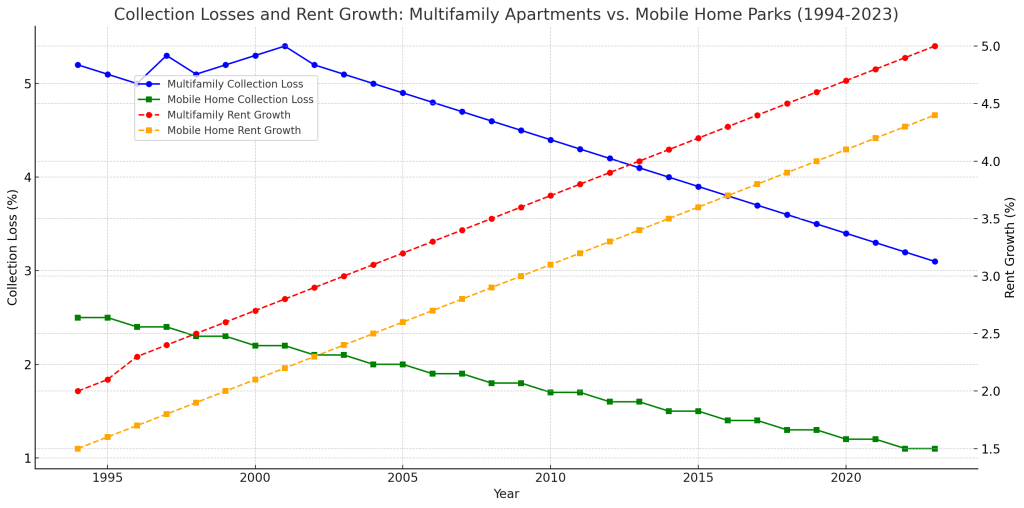
More evictions and removals increase our legal expenses and turnover costs. For tenant-owned units, we also handle the home and title process on an eviction. The biggest concern is collection loss. Preparing and leasing a unit can take 60 days, resulting in lost rent. A tenant behind by $700 might cost us an additional $5,400 in “shadow costs,” including up to $2,000 for legal fees and higher make-ready costs due to poor maintenance. This loss can total a low end amount of $5,400 for two months of lost rent and expenses. Therefore, it’s often better to find solutions to keep tenants in our community.
What We Look For to Consider Offering Options:
- ABILITY: Do they still have income or have they lost a job? Understanding their situation helps us find solutions.
- COMMUNICATION – Probably my biggest one, are they in communication with us about the situation? Are they not answering their phone or responding to texts? Do they answer their door or respond to the notices? All of this tells us how much they want to stay, and it’s not a matter of “not caring.” We want them to care, to try, to be honest, and work with us. Not avoid us; if they avoid us, we are left to assume the worst. For the tenants, this is the worst thing to do because it dehumanizes them with us and we go into automation mode—late fees, cut-offs, notices, evictions…
- CYCLICAL: Is this a one-time issue or a recurring problem? One-time events can be overlooked, but habitual offenders are different.
- FIT – Are the tenants a good member of the community? Are they well-liked, do they treat others well? Tenants that are not a good fit should not be given the same leniency as tenants that are great residents.
- CONDITION – Do the tenants keep a clean home? Is it damaged, clean of bugs and roaches? Is the yard well kept or is there trash and toys all over the yard? When you walk in the home, does it smell, or is it clean? The last thing you want to do is extend the stay of someone who can’t pay and is damaging your home and the community.
Options Other Than Eviction:
In my opinion, “No Pay, No Stay” is a general term, makes a great catchphrase, but doesn’t apply to all situations. If you use it as a hard line, you will be your attorney’s best friend and your investors’ worst.
We employ a variety of measures when we encounter a late payer in one of our communities.
- Installment Payments: We will spread a back-owed month over the next few months. We will try to keep them realistic amounts based on their income level and employment status, while not allowing it to get spread out too far into the future.
- Promise to Pays: Allow tenants to pick a date to pay without accruing late fees. This builds trust. You will be surprised how many people perform on the Promise to Pay Offer.
- Waive Late Fees: We charge an initial $35 late fee and then $10/day till they pay. This can add up. When communicating with a tenant, if we feel it is the right situation, we will offer to waive or pause late fees for a payment, often in conjunction with a “Promise to Pay” offer.
- Waive Back Owed Rent: When taking over a new community, you often will have delinquent accounts you inherit. It is a great option to knock door to door on those delinquent tenants and offer them a fresh start the coming month. Start them at zero if they will make on-time payments going forward. Again, for the right tenant, this will create a lot of goodwill and avoid costly turnover at the onset of a new acquisition. Besides, who cares about the rent they didn’t pay the last guy, we just care about them paying us going forward!
It is important to note, do not set them up for failure. You need to look at their new income situation and see what is affordable for them to create a successful situation. They stopped paying for a reason. Good people just dont pay their bills. Often something happened, it is our job to determine what it was that changed. Then find the right solution. Doing an installment sale on $1,000 owed rent and splitting it into two $500 payments probably won’t succeed if they took a drop in pay or lost a job. You might need to spread it out over 4 even 8 months to make it work. Same as Promise to Pays, do not set the promise to pay date the following week if you know they don’t have a check or income being received by then. It will only put you right back to where you started.
We had this happen in our community. A family that has been a resident for years had missed a month’s rent. Come the second month they were still late. Our management got in touch and tried to work out a solution; they typically pay $750/mo and were nearing $1,500 in back-owed rent. So they worked out an installment of $400 a week. The tenant suggested it and management said yes. Well, the next week came along and they didn’t make the payment. Same the following week. Turns out the husband lost a job and he had been trying to find a new one, which is why they didn’t make rent. He thought he could make the $400/weekly payment, but he didn’t start his new job and ramp up hours and pay at the rate he was expecting. Which led us back to a non-payment situation. I explained to our team that $400/week seemed outrageous for someone who just neglected to pay us $1,500 for 2 months’ rent. Their response, “he suggested the amount.” Which was true, but it is our job to determine if it’s realistic and creates a win-win scenario. We had to go back to the drawing board to get them on track, and once we did they continued to make their payments and are still a member of our community.
Late Payers Vs Non-Payers:
Late payers are not all bad. Most of the time late payers are just that—”late” but also “payers.” They do pay every month but just late. Those late fees equal extra revenue. We charge $10/day after the 5th. Many times that equals another $50-$100 per month from one tenant. These fees add up and over a large portfolio can become significant.
The late fees also give you negotiating room. For example, you may be willing to waive 50% of the late fee if rent is caught up by a certain date.
Now, non-payers are a different story. They are running huge delinquency balances with your community. They often may make partial payments but never catch up and always remain 1 or even 2 months behind on rent. This is a huge difference from a late payer. A late payer catches up and brings their account to zero each month, including fees. A non-payer never catches up. They are always delinquent and do not get their account to zero; fees and charges are also accruing. As a result, they provide no value like the late payer. Non-payers must be handled as we stated above, running through the steps to determine if we can work with them to get them caught up and keep them. Otherwise, we must move to evict. Dealing with perpetual payment struggles is a heavy burden for your management team. It can be draining month after month interacting with this tenant, hearing the same excuses, chasing payments, issuing notices; it will wear on your team. Better to deal with it than let it languish.
How to Avoid This:
Yes, we can avoid all of this with a better application process. We can only let in the best of the best. However, not all situations are perfect. Not every community will benefit from a high demand of applicants. Also, bad things just happen sometimes. We can limit those bad things by making sure even when absent of the perfect tenant, we still find qualified tenants for each community.
- Better Screening: When taking over a new community, we inherit a lot of problems from previous owners, especially mom-and-pop operators who don’t screen tenants. Screening is essential to proper tenant placement. We don’t just screen the applicant, we require all occupants over the age of 18 to be screened and submit an application.
- Income Verification: Every location is a bit different for income requirements, however many property managers run a 2-3x income requirement. If the rent is $1,000/mo they need to make anywhere from $2,000 to $3,000. For the majority of our communities, we prefer you spend no more than 30% of your gross income on rent, excluding utilities. If we have utilities included in rent, we will adjust that requirement. If they gross $3,000 a month then the tenant qualifies for $900/month rent.
- Reference Checking: This is essential, so many managers neglect this part. Even the ones that do call references don’t do it right. I heard a great tip once, it was to call the landlords and instead of stating the correct rent figure, make one up and see if they correct you. If they don’t, you may find you are talking to a friend of the applicant and not an actual landlord. Placing family and friends as references for landlords and employers is a common practice for many applicants. So don’t just ask yes and no questions that can be answered by anyone.
- Higher Deposits for At-Risk Tenants: This one has saved us a few times. We have been on the fence about a few people but needed to fill a unit. We took a few flyers and approved them only to be dealing with a removal a few months later. Some states may only allow you to take one month’s rent, others allow up to two months’ rent (or more) with an annual lease. If you can take two months’ rent, I highly suggest it when you have a tenant that seems like a good fit but is still riding the line of qualification.
Wisdom comes with Experience
I have never met an operator who enjoys serving evictions and kicking out families. They don’t want to knock on doors and serve notices; they would prefer to just have tenants that pay rent. Being at a lockout and removing a family with the sheriffs parked outside is an operator’s nightmare.
I have, however, met operators who run multi-million-dollar funds and portfolios who have never served one or locked out a tenant personally.
It is a matter that should be respected and avoided, if possible, with the ability and knowledge to enforce when necessary for the sake of the community and the investment.
I can say from my personal network in the industry, I notice more success and better performance from those operators that have real field experience. Listening to their stories of how they handle these situations and how they minimize their eviction ratio and legal expenses. Expertise and wisdom are heard within each story. Whereas, I have spoken to operators who sit behind a desk and rely on their team to handle these situations. They often tell me of their world-class screening process, applications, and background checks.
Yes, you can screen better on the front end. Let’s be honest, Murphy’s Law applies in the rental game. Bad things happen, jobs are lost, divorces happen, cars break down, and hours get cut at work.
What you do as an operator when those situations arise, because they will, will determine the quality of your operation. So we always run through our character checklist: Ability | Communication | Cyclical | Fit | Condition. Then we determine how we respond.
Any investor putting money into a deal with an operator needs to know how their operator will respond and function when hard times hit.
Check the legal expense line item, vacancy column, check the turnover rates… The numbers never lie.
Lock n Load
The MHP Operator
